DIO/ODI Hub — Manifest, publications, reference artifacts & updates · Derived Mappings · Reference Vocabulary
constraining_the_commit_boundary_v48 (4 November 2026); public arXiv:2610.37407 v1 is identified separately. Reference layer checked against Reference Model v0.5.0 and Reference Vocabulary v0.2.0.This mapping makes explicit the internal relations among the diagnostic inputs, domain-governed constraint binding, mutation-specific propositions, evidence states, two-phase Supervisor, commit invariant, assumptions, and prospective evaluation protocol described in working manuscript constraining_the_commit_boundary_v48. Its section anchors refer to that 4 November 2026 working draft; public arXiv:2610.37407 v1 is identified separately and is not presumed to have identical section-level wording.
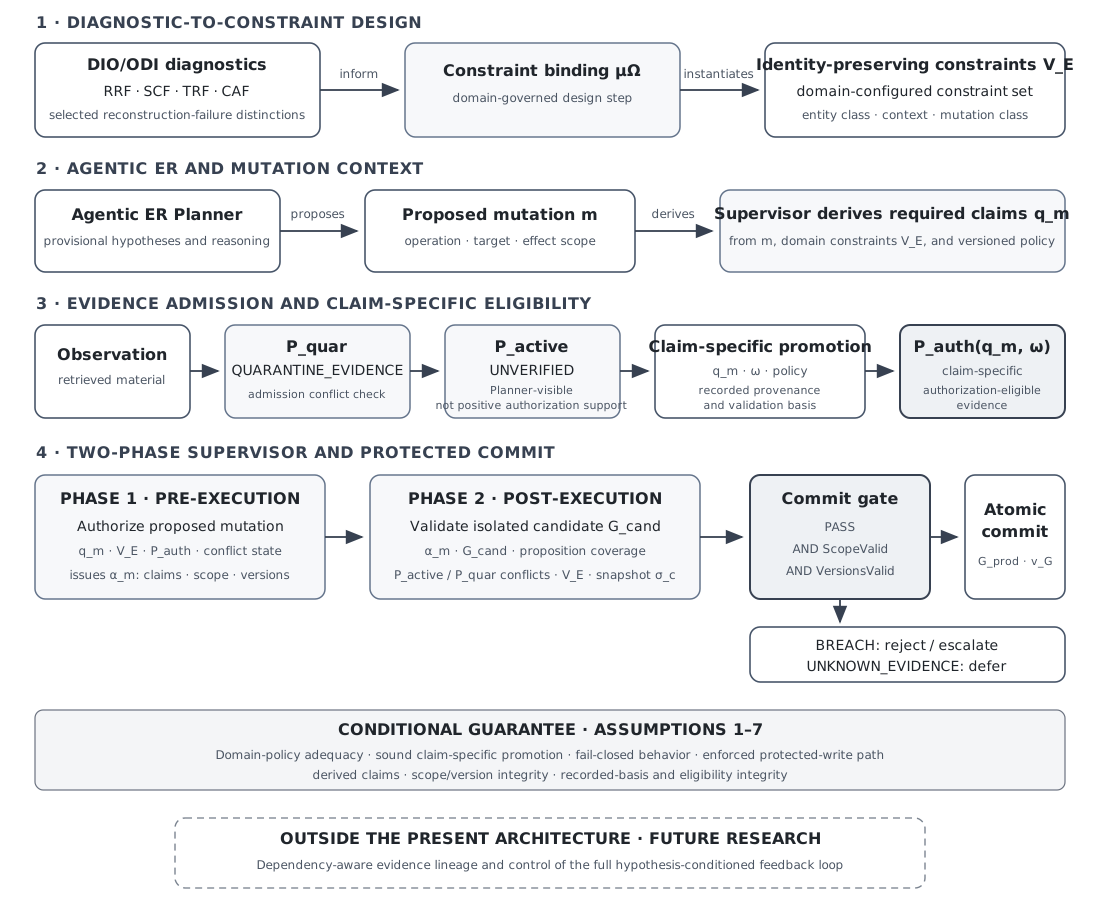
Diagnostic distinctions → domain-configured constraints → mutation-specific claims → claim-specific evidence eligibility → two-phase authorization → protected commit.
The architecture draws on the canonical DIO/ODI vocabulary. Selected referential, semantic, temporal, and contextual reconstruction-failure distinctions inform a partial, domain-governed constraint-binding function ϼΩ. Its output is a domain-configured constraint set V_E, not an automatic inference from SKOS hierarchy.
The paper also gives concrete but explicitly illustrative mappings from selected canonical distinctions to domain-level constraint patterns.
| Current DIO/ODI distinction | Domain-level constraint pattern | Authorization consequence |
|---|---|---|
| Entity Substitution / Merge Failure | Lexical similarity or commercial adjacency does not establish co-reference. | Do not merge without claim-specific evidence supporting the required co-reference proposition. |
| Temporal Discontinuity / Temporal Misalignment | Rename and continuity claims are bound to the relevant referent and validity interval. | Defer when temporal applicability or continuity is unresolved. |
| Semantic Fragmentation | Materially incompatible claims affecting identity remain a conflict until reconciled. | Clustering alone cannot resolve the conflict; defer the affected mutation. |
| Contextual Displacement | brand_of may be adequate in a brand catalogue but insufficient for legal-entity identity in a compliance context. | Preserve relation typing and require evidence appropriate to the observation purpose. |
| Split Failure / valid continuity | Documented, temporally applicable evidence may support that distinct records denote one continuing entity. | Resolve only when claim-specific evidence and applicable constraints pass. |
The Supervisor derives the required proposition set qm from the proposed mutation, its target/effect scope, and the applicable versioned domain policy. The Planner cannot substitute or weaken this set. The authorization record αm binds the derived claims, operation scope, and relevant versions.
Observations enter quarantine before possible admission to Pactive as UNVERIFIED. That status permits Planner reasoning but is not positive authorization support. A separate claim-specific promotion process establishes eligibility for a particular proposition, role, observation domain, and temporal applicability. The eligible set Pauth(qm, ω) is a subset of Pactive, not a separate physical repository. Promotion excludes recorded shared-origin observations from independent corroboration and excludes shadow-derived claim bases. Authorization-eligible evidence can carry support, contradiction, or unresolved-indication roles; eligibility is not a verdict that a source is universally true.
Phase 1 evaluates the proposed mutation and, on PASS, issues αm. Phase 2 validates the isolated realized candidate, re-derives qm, checks proposition coverage and conflicts, and verifies scope and versions against a consistent commit snapshot σc.
A protected commit requires EvaluateGraphConstraints = PASS, ScopeValid, and VersionsValid. Status precedence is BREACH > UNKNOWN_EVIDENCE > PASS. UNKNOWN_EVIDENCE leads to HALT_HITL only when policy requires review and a reviewer is available; otherwise it leads to DEFER_UNRESOLVED. Human adjudication requires a fresh authorization decision against current versions. One common retry budget applies across both lifecycle phases.
The invariant is conditional on seven assumptions: domain-policy adequacy, correct claim-specific promotion, fail-closed authorization, enforced protected-write classification, Supervisor-derived claims, scope/version integrity, and integrity of the recorded promotion basis. The mapping does not claim semantic correctness or detection of unrecorded provenance dependencies.
The protocol compares Baselines A, B, and C with a DIO/ODI-informed Challenger. Baseline C versus Challenger isolates the incremental mapping question. The comparison controls the case inventory, domain facts, evidence-promotion process, validator class and configuration, action resources, and decision budget; policy-derived qm differences are reported. Case construction is independent of frozen policy authorship and includes a taxonomy-neutral stratum. Baseline C authors are blinded to the DIO/ODI diagnostic mapping and Challenger policy. Prior DIO/ODI exposure is recorded; stronger inference requires independently constituted author teams allocated randomly or by expertise blocks, with uncertainty reflecting between-team variation.
Task- and policy-family-specific margins for acceptable coverage loss (δ_SRC) and false-commit increase (δ_RFCR) must be justified and fixed before outcomes, together with the uncertainty procedure. The binding success routes are (1) LS > −δSRC and UR < 0, or (2) LS > 0 and UR ≤ δRFCR. The uncertainty procedure must account for the two-route OR structure (e.g. simultaneous bounds or another justified multiplicity-control approach). If RFCR is undefined in either condition, RFCR-based routes are non-evaluable. Correctness, safety, admissibility, resolvability, and benignness use a common independent evaluation reference; PEVR separately assesses each condition’s operational contract.
No experimental results are reported. A generic baseline that matches or Pareto-dominates the Challenger counts against incremental mapping value for the task and policy family tested, not against DIO/ODI as a broader framework.
Dependency-aware evidence lineage and control of the full hypothesis-conditioned feedback loop are explicitly outside the current architecture and remain future work.
Markdown source JSON-LD Turtle RDF Architecture SVG
The qualified relation assertions include a source section, an interpretation note, and an epistemic status: specified, assumed, illustrative, proposed-evaluation, or future-research. These assertions remain in the derived architecture namespace.
This artifact is complementary to the DIO/ODI Commit-Boundary Contract – Policy-as-Code Authorization mapping. The present mapping reconstructs internal architecture relations; the existing mapping projects selected authorization obligations into OQA/Rego and Cedar capabilities and integration requirements.
The section-level anchors align with the author’s unpublished working manuscript dated 4 November 2026. The public arXiv citation identifies version 1 separately; the working manuscript is not presented as a published bibliographic source.